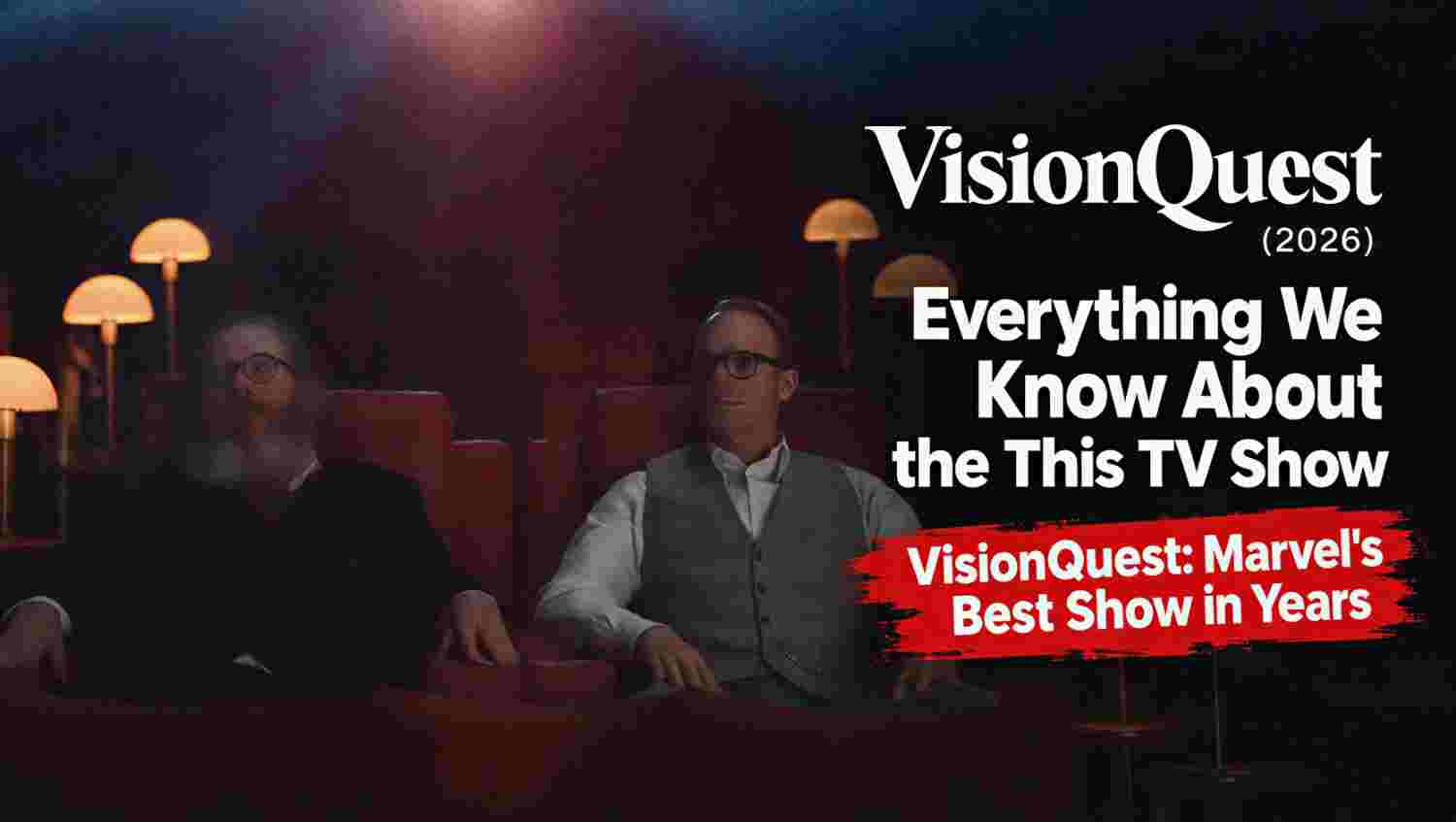
The final series in the WandaVision trilogy follows White Vision, hiding in Edinburgh, as a bounty hunter and a boy carrying Tommy Maximoff's memories pull him back into danger.
The pub in Edinburgh is so quiet that Vision (Paul Bettany) is like a man doing his job without knowing what it is. He’s very polite, very careful, and very pale. He also has a wife and two sons somewhere in his mind, but the memories are like another man’s photo albums. Up in the attic, Ultron (James Spader) is in his head, in a manor house that doesn’t exist anywhere else. But in the real world, a Scottish teenager wakes up with a dead boy’s memories, and it’s about to be very difficult to hide. How long can anyone evade a past they can’t feel?
It’s the scene for Marvel Television’s VisionQuest, the final installment of a trilogy that began with WandaVision and continued with Agatha All Along. The title is a pun, but a useful one. A vision quest is a solitary journey that should leave you a different person. Showrunner Terry Matalas and his writers take White Vision on one, and the destination is personhood.
He has a lot to tidy up. The original Vision had his humanity, and he lost it when he died. The husband and father Wanda Maximoff (Elizabeth Olsen) conjured was a borrowed one, a version of him that was inside her Hex. This one is not that one. He’s not the warm, curious android he once was, and he’s not the weapon S.W.O.R.D. wanted him to be, either. Oddly, he is more bothered about who he is than the killer robot upstairs.
ALSO READ: Treasure Island TV (2026) Review, Parents Guide & Age Rating
About that attic. The manor is a virtual replica of a family home, and Vision shares it with the A.I. family members from Tony Stark’s old lab: J.A.R.V.I.S. (James D’Arcy), E.D.I.T.H. (Emily Hampshire), F.R.I.D.A.Y. (Orla Brady), D.U.M-E (Henry Lewis), and U (Jonathan Sayer). They are his helpers, each doing what they were created to do to help him through his day. This is an unusual table, and Ultron is the leader of it, and he thinks of himself as Vision’s father. He’s still murderous and still very funny, and he’s now stuck in a house with the son he once tried to kill. If you’ve watched Inside Out, imagine that busy control room, but with a homicidal dad controlling the thermostat.
Then there’s the boy. Thomas Shepherd (Ruaridh Mollica) was almost killed and returned with the memories of Tommy Maximoff and his speed. Vision doesn’t want to be anyone’s father because, in his mind, that life was for someone else. But Thomas has a problem, as the assassin Paladin (Todd Stashwick) has him as his hostage. When a bounty on Vision draws the two of them into the same pursuit, there’s also a kleptomaniac named Lisa (T’Nia Miller), a serial killer named Butcherbird, and, before you get to the Marvel Comics references, there’s more.
There are many of these. It starts with the original Human Torch, Synthetic Man from 1939, and it mentions Tony Stark, Bruce Banner, Daredevil, the Punisher, and Werewolf by Night, or Man-Wolf, if you count. It sounds like a mess on paper. It’s a cyberpunk family adventure with a passion for old television and pop culture films, and it’s nothing like its two predecessors in practice. WandaVision was a psychological sci-fi thriller, while Agatha All Along was a portal fantasy with witches. This is something else again.
Matalas has cited Spock’s voyage in Star Trek IV: The Voyage Home as an example of Vision’s, and it’s a fitting one. It’s a tale of a mind that’s rebuilding its emotions from the outside in.

This is my idea of what works best. The show keeps its feet on the ground. Matalas and company take a cue from Junji Ito in horror, creating the weirdness from the mundane. A house, a family, a father and a son who don’t understand each other. After purchasing the household, you’ll be able to follow the show anywhere, even into an A.I.-filled mind. That’s why the big sci-fi questions don’t seem like homework. When does something synthetic become real? Who is in the family? Is there a soul in the body, or in the memory of the body? These questions are hitting harder than they did five years ago, given the amount of discussion about artificial intelligence these days.
ALSO READ: East of Eden TV (2026) Review, Parents Guide & Age Rating
It does fall in love with its own poetry now and then. Sometimes a line like “What is grief, if not love persevering?” is a good one, but the show knows it, and sometimes it has a character say a line like that when a quieter beat would have done the job. And it can be a bit goofy. I didn’t mind, and I would say the goofiness is what keeps the sincerity from turning into pretension. The retro look and the sharp, overlapping banter help, too.
There are so many cast members that I’ll just stick to the ones that stuck with me. Bettany and Spader do what you’d expect and more. Spader’s Ultron is the most hilarious and the meanest. The actual treasure is Mollica. He’s a bit of a character in his Thomas, and he never uses the kid as a plot device. Miller’s Jocasta is no exception, and her intent remains ambiguous. I wouldn’t be surprised if she and Spader both get into the Emmy discussion, particularly for Episode 6. Morais steals scenes as Lisa, and Hampshire is great as E.D.I.T.H.
The heart is fathers and sons, siblings, and sacrifice. It’s also a love story, in several forms, which is appropriate for a trilogy that has always been rooted in big love stories. There are lots of twists, but there aren’t too many, and they’re pretty fast.
The TV-14 rating is appropriate. It’s a show about a hostage, a hired killer, a serial killer, and an A.I. father who’s never apologized for anything. The threat is genuine, and the tone around it is lighthearted, and that’s something that Marvel does well. It’s also a show about loss and children, though, and that’s too much for a younger kid. If you were able to do WandaVision and Agatha All Along, you should be fine. Otherwise, watch the first episode yourself first, and be prepared to discuss what arises.
What is the rating of VisionQuest?
The TV Parental Guidelines have rated VisionQuest as TV-14. The rating is not accompanied by any official content descriptors, so the reasons for the rating have not been published on Disney+. The breakdown below is based on the information available at this time and will be revised with accurate numbers once all episodes have been viewed.
Conclusion
The story starts with White Vision hiding in Edinburgh, searching for something to feel in his life. A bounty on his head and a boy with Tommy Maximoff’s memories push him out of hiding, and a roomful of A.I. relatives debate in his mind. In eight episodes, it combines cyberpunk pursuits, family drama, and a lot of jokes, but there are also real questions of identity and artificial personhood lurking beneath.
Content guide: TV-14. Prepare for action, a hostage situation, a serial killer, and themes of grief and identity. There is no sexual content reported, and language details are not confirmed beyond at least one deity-based expletive. Alcohol is present in a pub environment, and there is no report of any drug use.
Recommendation: If you enjoyed WandaVision or Agatha All Along, or if you enjoy stories about artificial beings searching for meaning, then watch it. It’s easy for newcomers to follow, but Easter eggs are more plentiful for fans of the franchise. Parents of younger teens should watch an episode first.
Reference Sources
- VisionQuest on Disney+ (official listing, TV-14 rating and synopsis)
- VisionQuest on Wikipedia (cast, directors, release schedule)
- Dork: VisionQuest receives TV-14 rating ahead of Disney+ debut

Rebecca Hollis is the founder of Screen Parent Guide and a film content analyst with seven years of experience reviewing films for an independent ratings consultancy. A Film Studies graduate of Emerson College, she specialized in content classification and how ratings systems communicate, and often fail to communicate, what families can expect from a movie.