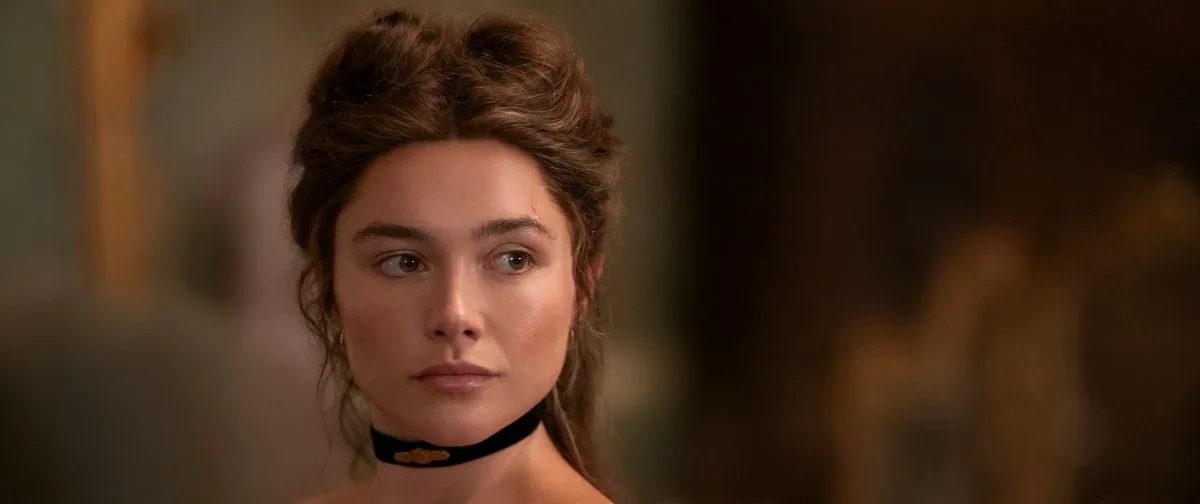
A woman on a farmhouse porch in the Salinas Valley is beaten and bleeding, unable to explain who has beaten her. She gives only her name, Cathy (Florence Pugh), as if choosing a coat from a rack. He whisks her away and immediately falls for her: Adam Trask (Christopher Abbott). His brother, Charles (Mike Faist), watches her like you can’t help but love a stray dog. He doesn’t trust her, and he doesn’t hide it. What does she have up her sleeve, and what does she want from two men who can barely hold their household together?
For years, Netflix has been drip-feeding reports on this project. The series is written by Zoe Kazan and directed by Garth Davis, with a total of seven episodes. But the story doesn’t begin with Cathy. It begins with the Trask boys, who have a father, played by Mark Lee Drushal, who is a stern public figure but plays favorites when it comes to his sons. Adam is one of the people from whom Cathy wants approval. Charles receives less of it, and his resentment grows early. Later come Cathy’s boys, Cal (Joseph Zada) and Aron (Joe Anders), who inherit the mess.
The neighbors are Samuel Hamilton (Ciarán Hinds), a character who’s easy to like on his own merits, and Lee (Hoon Lee), a virtually mythic character from the story, more akin to a conscience than anyone else, even within his own family. He runs about the farm performing the various menial tasks that keep the household going. Martha Plimpton also turns up as the madam of the brothel from which Cathy got some of her rules.
But if you’re familiar with the 1955 James Dean movie, put that aside for now. This is the latest adaptation of Steinbeck’s novel, while Elia Kazan, Zoe’s grandfather, directed the earlier film. There is room to return to the beginning, and this version feels more like an American family saga than a literary costume party. Consider Giant or There Will Be Blood: great scenes of vast vistas, minuscule evils, and fathers who leave behind scars that look a bit like the weather.
So, is it good?
Yes, most of the time, and much of that is due to Pugh. Viewers have been generous with their commentary. The series receives around 88 percent on Rotten Tomatoes, and her name was singled out in NPR’s review.
However, that’s the thing about Cathy Ames: she has always been a character who demands attention. She has been a favorite of readers since 1952. Some say she is Steinbeck’s most brilliantly developed character; others refer to her as a misogynist’s cartoon of evil.
The series doesn’t take sides by making her either a hero or a villain. She still lies, she still has a way of coaxing manipulations out of herself, she still burns a house down, and she still walks away from her children.
Why is she changing?
Her savagery feels like a learned habit, the result of a woman who was taught in her youth that people are not to be trusted. Pugh plays that beautifully, too, with the most minuscule of movements: a look held half a second too long, a posture adjusted to appear harmless.
The drinking scenes are the ones to watch. The minute the wine or champagne goes down, her guard falls, and the mood shifts like a horror film when the killer appears at the door on the stairs.
We also have the argument surrounding the show’s central decision. The key to Steinbeck’s great idea is timshel, commonly translated as “thou mayest,” which means you do not have to be stuck with the sins of your parents. Cathy is the test case, someone who might have done something different but didn’t, or perhaps did.
Instead of telling you what to think, the series shows you what happens. I applaud that, although sometimes the philosophy goes on a little too long for the length of the story.
The arguments are weaker. Pugh is so powerful that when she is not there, everything feels thin. At times, it doesn’t feel as if the rest of the series can quite keep up with her.
The obvious loser is Adam. He’s been written as the good guy, and good guys are hard to render interesting on screen. Abbott has basically been allotted a troubled face and a different version of misery, which makes the character feel less compelling than he should.
Charles receives less favorable treatment, too. It is Cal, the more grizzled big brother, who emerges as the stronger character, and Zada’s portrayal of a naughty yet curious younger brother adds another layer to the family dynamic.
It’s also unfortunate that much of the Hamilton family’s story gets lost, because Hinds and Lee are the show’s warm heart.
There’s the look, too. The filmmaking thrives on darkness within enclosed settings and the darkness of night, creating an atmosphere of gloom and doom. It can also make the series difficult to watch at times, and there are moments when you will find yourself squinting. Viewers have also pointed out that it takes some time to get into the story, as the first few episodes are particularly dark.
I think it’s an even trade. This isn’t background TV.
A word before you press play
The show explores topics including child abuse, violent family conflicts, sex work, and a protagonist who sees people as furniture. Abuse, brutal violence, sexual content, nudity, and the treatment of Native Americans all warrant a warning to audiences.
Movieguide, a faith-based review site, has also highlighted the movie’s use of such themes. The dark material is woven throughout the story rather than confined to a pair of skippable scenes.
Directed by: Garth Davis
Starring: Florence Pugh, Christopher Abbott, Mike Faist
Format: Seven episodes
Running time: Seven episodes (the premiere runs 51 minutes)
Netflix release: October 1, 2026
Updated: October 10, 2026
Why is East of Eden rated TV-MA?
East of Eden is rated TV-MA by Netflix for sexual content, nudity, violence, and some language.
Violence: The show begins with a woman who is beaten up and bloody on the front porch of the Trask house. A father repeatedly spanks his young boys with a switch. One of the brothers kicks and punches him until he bleeds and pleads for him to stop.
Soldiers assault an encampment of Native Americans. Gunshots can be heard, along with women and children crying, although the violence is not shown directly.
Cathy sets fire to her family home. Throughout the series, she murders several people and abandons her children.
Sexual Content: Two brothers are involved in a brothel encounter, one of whom hires a prostitute. Part of the activity appears to involve dancing, and an object may be heard rustling in the background before the woman is offered to his brother, who seems reluctant to accept her.
One of the key themes is the sex trade, including the experiences of a young woman working in a brothel. In a few scenes, individuals are seen engaging in sexual activity, and Cathy uses seduction as a means of control and survival.
Nudity: There are some brief instances of nudity, including male rear nudity and limited nudity involving women in the brothel scene. Common Sense Media also notes scenes involving breasts and buttocks. Male characters sometimes appear shirtless outside sexual situations.
Profanity: The TV-MA-rated drama contains some profanity, including at least one reference to God in the premiere. Exact counts should be confirmed by screening the episodes.
Alcohol/Drug Use: Characters drink and smoke throughout parts of the story, reflecting the period in which it is set. Alcohol is an integral part of Cathy’s character and is portrayed as a threat rather than a source of pleasure.
Sources and Further Reading
- Netflix Tudum: When Is East of Eden Coming Out?
- Netflix: East of Eden Official Series Page
- Australian Classification: East of Eden, Limited Series Episodes 1 to 7
.

Rebecca Hollis is the founder of Screen Parent Guide and a film content analyst with seven years of experience reviewing films for an independent ratings consultancy. A Film Studies graduate of Emerson College, she specialized in content classification and how ratings systems communicate, and often fail to communicate, what families can expect from a movie.