A free-to-play anime turn-based RPG where you collect and train star-powered girl characters, build teams, and fight story and PvP battles. New characters come from random gacha pulls.
The lights are going out all over. Star Savior begins with you as the new Captain, leading a group of star-powered girls called Saviors on a trial called the Journey. The legendary Star Savior fought the Void Star and left behind a great power. Now someone has to take it over, and the dark clouds are gathering with each passing day. You’ve got a team, a few pulls, and a lot of enemies. But which Saviors are worth building, and which ones will eat your upgrade materials for free?
That’s why tier lists exist, and that’s why this guide is important to anyone, even parents, who wants to understand what this game demands of its players.
Star Savior is a turn-based gacha RPG from Studiobside, the Korean studio behind Counter: Side. All the game is played by female Saviors with star powers. You gain characters in six roles (Defender, Striker, Ranger, Caster, Assassin, and Supporter) and five attributes (Sun, Moon, Star, Order, and Chaos). The battles are animated with cinematic flair and the best teams are created by synergy, not rarity.
The stakes are simple. The right characters and story, boss fights, and PvP ladders open up. Pull the wrong ones and you hit a wall. The formula will be familiar to anyone who has followed a rising star in Epic Seven or Honkai: Star Rail, but Star Savior takes a more anime-focused approach and the Saviors’ relationship system.
This is the straight and narrow answer. Star Savior is beautiful and fun to play, but it’s a gacha game all the way. It’s asking for your time, and it’s not asking for your money. The SSR rate is 4%; Arcana characters and cards have a 2% rate up, and there’s no 50/50 guarantee. That’s why it’s important to make a smart choice in most of the games of this kind. A good tier list isn’t about bragging rights; it’s about saving resources, and for parents, it’s a quick way to know why a teenager might be so interested in one character.
The Teen rating is easy to understand after an hour of playing the game. The violence is stylized, the costumes are suggestive, and monetization is where a parent should pay the closest attention. I’ll go through everything below. My recommendation: If your child plays, read the tier list; if you’re considering whether your child should play, read the content breakdown.
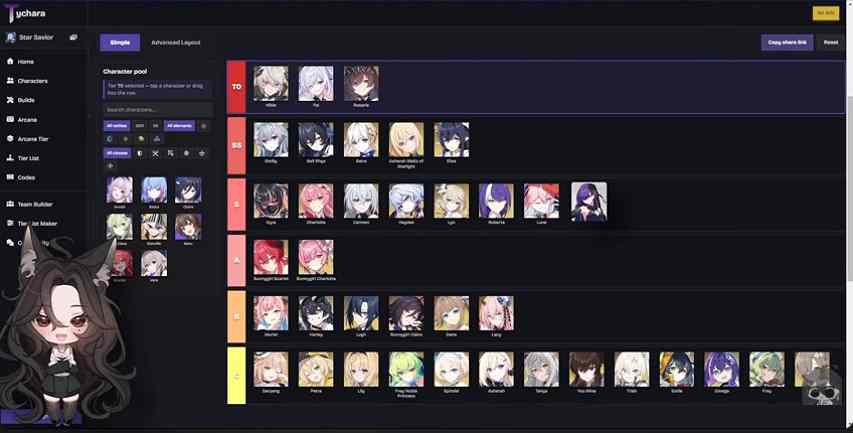
Star Savior Tier List (October 2026 Update)
Tier lists vary from site to site and change with each patch. This ranking is a combination of the most consistent placements from multiple community rankings, including PvE (story and bosses) and PvP. There’s one recent change that’s important to know. The new characters from the July 2nd update were the new Savior Ceres and buffed some of the characters that were struggling, particularly Kyra, Seira and Trish. Any list, including this one, is a good rule of thumb, but not a rule.
S Tier: Build These First
Currently, the S tier consists of Emily (Tank), Asherah in her Waltz of Starlight form (Support), Bunnygirl Charlotte (DPS), Lacy (Support), Bell Rhys (Support), Seira (DPS), Luna (DPS) and Muriel (Caster).
Emily is the most secure initial investment. She is a good addition to most PvE teams and is also good in PvP.
The highlight of the support is Asherah (Waltz of Starlight). Be aware that the base version of Asherah is much lower, so be sure to pull the correct one.
Bunnygirl Charlotte is a high-damage performer in both modes.
Muriel is a hard-hitting caster for crit-heavy builds and difficult boss fights.
• Lacy and Bell Rhys provide utility in your support slots to make all damage dealers better.
Seira and Luna provide consistent damage, with Seira benefiting from the July balance changes.
A Tier: Strong and Dependable
A tier consists of Hilde (Tank), Dana (DPS), Haydee (Tank), Tanya (DPS), Lydia (DPS), Elisa (Support), and Charlotte (DPS). When constructed correctly, these units will clear most content. They typically only lose to S-tier picks in versatility or lack of synergy, so feel free to use them until you get a better pull. Especially Hilde is a tank that doesn’t need any gimmick to be useful.
C Tier: Inconsistent Picks
Bunnygirl Scarlet, Harley, Serpang, Epindel, Frey, Omega, Smile, and Lugh can still be used in certain scenarios, but they are not as versatile as higher tier options. Use them when type advantage is important or when you have no better. Don’t waste precious resources on them until you have your S-tier core ready.
A Note on Disagreement
Not all lists are in accord. Frey (Noble Princess) and Eternal Promise Carmen are ranked higher than above in some community rankings, and characters such as Seira and Charlotte are ranked higher in PvP rankings. For those who play mostly PvE, focus on Emily and add in S-tier units that can be used in both modes. If you’re playing PvP, please look at the current ladder meta before spending.
Reroll Advice
If you’re new, the most popular suggestion is to keep rerolling on a guest account until you get one of the S-level Saviors. This is free, but it takes time and is the reason why many players begin with a better account than their friends.
Star Savior is one of the more well-made gacha RPGs because of its approach to team building. A good Defender, a smart Supporter, and a tough Striker will always outperform a random collection of rare cards. That’s good, and it’s what keeps players pulling, upgrading, and checking the banner every day. Parents who see their teen planning a team on paper are watching a strategy game at work.
The game is rated Teen, and it’s appropriate. There’s nothing dark in the premise of the story; it’s a fantasy adventure about stars, trials, and a defeated void. The concerns are related to the presentation and the business model. The costumes may be revealing, the gacha system involves random item purchases, and the multiplayer aspect allows players to interact. I just feel that this is a game that most teens can play with some supervision, but I would not give it to a younger kid without talking to them about spending. My recommendation: limit the purchase of the device before the first download.
How to Invest Your Resources Wisely
One of the most crucial aspects of StarSavior is character progression. Players should stick to a handful of characters that can do multiple content types, as upgrading all available units can be a significant resource drain.
Focus on your core team: Pick a reliable defense team, a primary damage taker, and at least one character that provides useful support. As new encounters require new skills, add more members to your team.
Do not upgrade all at once: It is easier to progress through levels with a few trusted characters than with a whole collection of characters.
Make investments in skills to solve problems: Damage upgrade is useful when enemies live for too long. The more often your team loses characters, the more important the defensive skill is. The most effective investment is the one that solves your problem.
Think twice about duplicate investments: Performance can be impacted by breakthroughs and other character enhancement systems, and the benefit of extra investment differs from character to character. Don’t waste precious resources on a character that already does its basic function without any enhancements.
Review equipment and Arcana: Character rankings are not standalone. The right gear, Arcana, and skill levels can make a significant difference in performance. A poorly developed unit can be beaten by a lower-ranked character with a good build in the right encounter.
Save resources for new releases as appropriate. New characters can alter the meta, but it’s not always necessary to chase every banner. Before spending your currency, determine if a new unit addresses a real need in your roster.
Common mistakes to avoid are listed below:
Selecting characters for rarity: Not all rare units are necessarily the best solution to every problem. Skills, team synergy, and encounter mechanics are important.
Ignoring defensive support: If the attackers are a team, they can have trouble when the enemies live long enough to strike back. More protection can lead to more damage, as your attackers will remain alive.
Using one team for every mode: PvE and PvP give different rewards. Make alternative characters, don’t assume one formation will be used all the time.
Ignoring character variants. Asherah and Waltz of Starlight are not the same and should not be used interchangeably. This is the same for other alternate character versions.
Following old tier lists without thinking: Character value may change with a balance update or a new release. Look at the date of a publication and the assumptions used in a ranking (such as character investment and game mode).
Why is Star Savior rated Teen?
Star Savior has been rated Teen by Google Play due to Violence and Suggestive Themes. The Play Store listing also mentions that users interact and that in-game purchases are random items. Sexual Content or Nudity is one of the age rating descriptors listed on the App Store.
Can StarSavior be played by younger players?
StarSavior is a fantasy role-playing game with stylized anime characters, turn-based combat, character collection, and progression systems. While it might look colorful and inviting, parents should take a look at its combat, character designs, online capabilities, and random purchases before determining if it’s right for their child.
The Google Play listing classifies the game as Teen, and it has the following descriptions: violence, suggestive themes, user interaction, and in-game purchases of random items. The Steam listing also includes a warning for fantasy violence, sexual themes, and revealing character outfits. The ratings and descriptors may vary from platform to platform and region to region, so please verify the latest listing for the version you wish to play.
I would recommend that you check the character artwork and buy the systems before letting younger players play the game. Anime fantasy and strategic combat fans might enjoy the game, but families should be aware of spending controls and the appropriateness of character presentation.
Game Information and Content Guide
Title: StarSavior
Developer and Publisher: Studiobside
Genre: Turn-based role-playing game, strategy, anime fantasy
Release: December 10, 2025, on Steam
Platforms: PC and mobile platforms, subject to regional availability
Business Model: Free-to-play, with in-game purchases
Age Rating: Google Play states the game is for Teen. Steam offers extra information about mature content.
Gameplay Content: Fantasy combat, anime-styled character artwork, suggestive themes, character collection, and randomized in-game purchases.
Online Features: Steam’s listing of features includes online interaction and in-game chat.
Profanity: There is no reliable, comprehensive count of profanities in the dialogue and updates of the game in the sources used for this guide. It would therefore be misleading to give an exact numerical breakdown.
Alcohol and Drug Use: There is no reliable, comprehensive scene-by-scene inventory for this guide. If this is a deciding factor for you, check the current content disclosures of the game.
Violence: Fantasy battles include health-based damage systems, attacks against enemies, and combat animation. The presentation is not a realistic depiction of combat, but rather stylized.
Sexual Content and Suggestive Themes: Some character designs and outfits are revealing, and the platform disclosures mark suggestive or sexual themes. Steam’s description states that the game does not depict sexual acts or sexual assault.
In-App Purchases and Gambling Mechanics: The game is free but has random items for sale via its gacha system. As mentioned above, the top rarity rate is low, and there is no guaranteed pity on a 50/50 pull, so spending can add up rapidly. There is also the option to interact with other players online.
Conclusion:
Star Savior is a sleek anime turn-based gacha RPG in which you will be a star-powered Savior who will be tasked with inheriting the legacy of the legendary hero who defeated the Void Star. It’s all about pulling and building the right characters to succeed.
Tier list takeaway: Start with Build Emily, then add in Asherah (Waltz of Starlight) and Bunnygirl Charlotte, then add in Lacy, Bell Rhys, Seira, Luna, and Muriel, and use A- and B-tier characters as fillers. Watch out for balance patches, as the meta has already shifted in July.
Content warning: This is a TEEN rating. Stylized fantasy violence, suggestive character interactions and costumes, random item purchases, and online interaction. There is no drug or alcohol content reported.
Recommendation: Ages 13 and older with parental supervision. Parents should either disable or limit in-app purchases, discuss the concept of gacha odds, and preview the costume and relationship content before allowing the download. If you’re a younger child or family looking for a full-on experience, you should seek something different.
Sources and Further Reading
For the latest character rankings, gameplay details, and content disclosures, consult these resources:
- Pocket Gamer’s StarSavior Tier List, October 2026, for separate PvE and PvP rankings.
- Game.Guide’s StarSavior Tier List, for a comparison of multiple community tier lists.
- Official StarSavior Website, for the game’s setting and character background.
- StarSavior on Google Play, for platform information and age rating.
- StarSavior on Steam, for PC availability and the developer’s mature content disclosure.

Rebecca Hollis is the founder of Screen Parent Guide and a film content analyst with seven years of experience reviewing films for an independent ratings consultancy. A Film Studies graduate of Emerson College, she specialized in content classification and how ratings systems communicate, and often fail to communicate, what families can expect from a movie.