Bitter Christmas is Rated R by the MPAA for some sexual material, including sexual talk and a stripper character's routine
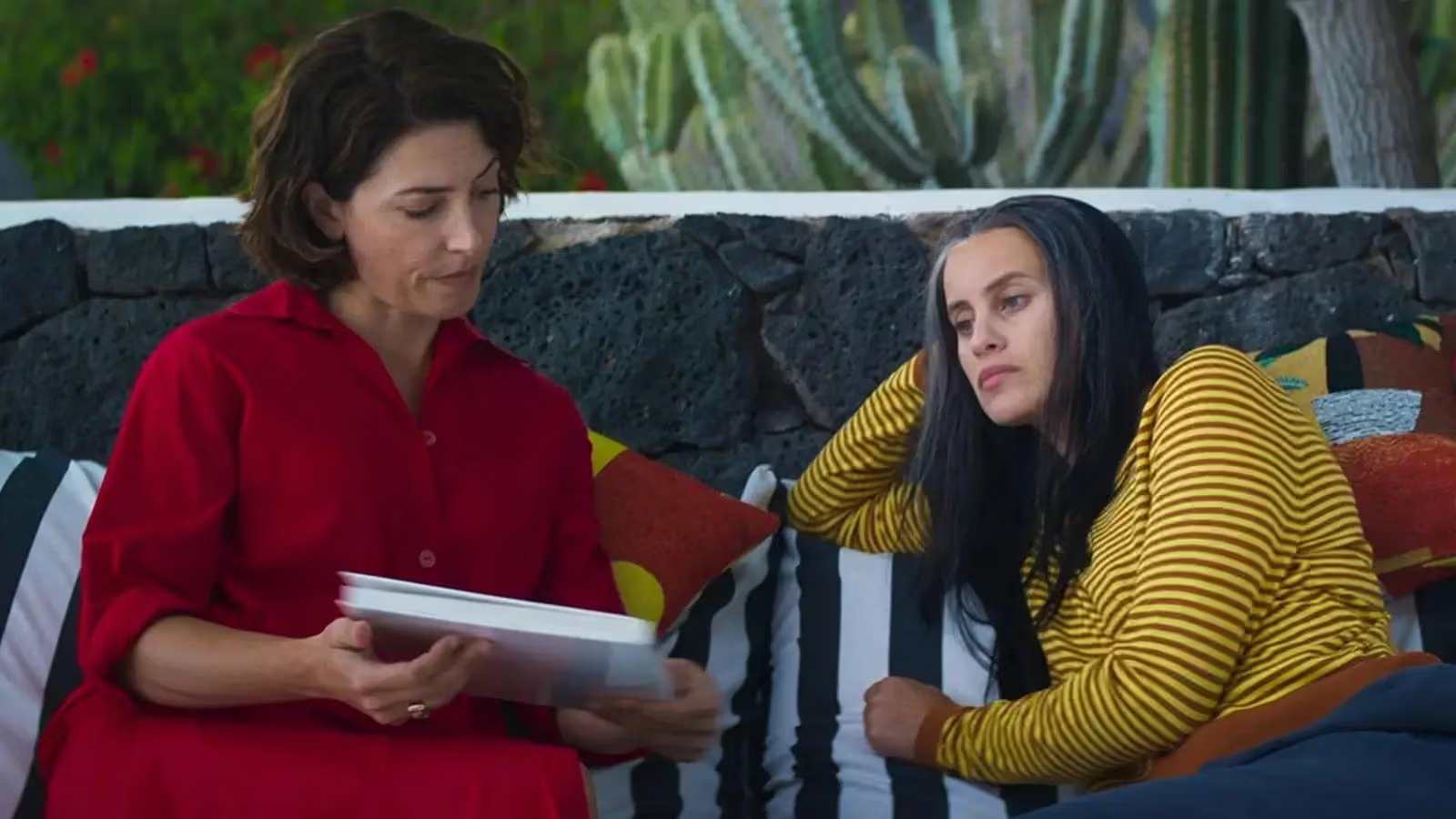
When life gets difficult, Elsa (Bárbara Lennie) does her best to keep busy. The advertising director, after the death of her mother, throws herself into work and takes on more responsibilities than she gives herself time to grieve. It lasts for a time, until her body tells her what her mind will not. Eventually, her panic attack makes her slow down, and she decides to leave Madrid and go to Lanzarote with her friend Patricia (Victoria Luengo).
It sounds like just what she’s looking for. That’s the half of the story that Pedro Almodóvar has for Elsa. In an alternate universe, one man’s life is being dramatized by the other man who works in the film industry. Bitter Christmas is about more than just the possibility that fiction can come close to real life. That question is whether or not an artist should be able to take someone else’s suffering and use it to craft a better tale.
The Story Behind Bitter Christmas
The movie alternates between two eras: December 2004 and the summer of 2026. Initially, there is no clear link between the two timelines. One follows Elsa and the people in her personal circle, and the other introduces Raúl (Leonardo Sbaraglia), a screenwriter and film director, who is looking for material for his next feature film. Gradually, as the stories unfold, Almodóvar reveals how intertwined they are initially.

Elsa’s problems start with a loss she has not been able to deal with. Her mother dies in the December vacation, upsetting her. Rather than taking time off from work, Elsa takes on assignments and stays on the job. Something familiar in her response. Some people become very quiet when they are grieving, whilst others fill every hour as they seek to avoid the sensation of sitting alone with their thoughts. Elsa is a member of the latter group. Unfortunately, there is no way to ignore grief.
ALSO READ: Christmas at the Kringles (2026) Review, Parents Guide & Age Rating
During this time, her boyfriend Bonifacio (Patrick Criado) becomes an important part of her life. He is a fireman, and at the same time he’s also a man who strips women. Somewhat of an odd bedfellow, but the combination brings some of the weirdness of Almodóvar’s films. He is also the one who she turns to when she can’t deal with her anxiety. The bond they share offers some moments of love and humor, but is not a successful healing, even though love is a solution to all the emotional issues.
Eventually, Elsa decides to go to Lanzarote and brings along Patricia. Patricia has her own reason why she wishes to leave Madrid. Her marriage isn’t working well, and her husband’s infidelity has left her with a problem that she can’t just turn a blind eye to. She’s also busy coping with the responsibilities of family life, and has little spare time to think about what she really wants. The holiday is not only a break from her normal routine for the women, but it is not a holiday where they are seeking the same things either.
One of the more interesting aspects of the story is the friendship that they have, which is not a perfect friendship. Elsa and Patricia do not get along perfectly, nor do they have no problems or disappointments in their own lives. They can provide one another with company, but neither one woman can make the other’s misfortunes go away. Almodóvar doesn’t mask them; he doesn’t want them to be used as a comforting friendship.

They are mixed with another thrust of pain when you’re added by Natalia (Milena Smit). She is going through the grieving process for her young son’s death, which is causing her a lot of depression. Her situation is significant due to the fact that it becomes tied into the film’s bigger idea regarding how to use personal tragedy in art. While Elsa’s loss of her mother is hard enough to bear, Natalia’s loss brings a new kind of loss, affecting the people in her surroundings.
This is where the second narrative takes on more significance. Raúl has a long creative slump as a filmmaker. He is looking for a narrative, and the content he ends up with is from his own personal surroundings. He doesn’t invent his own world, but rather starts to draw upon the lives of those he knows. His screenplay slowly unfolds in relation to the events and relationships that are similar to Elsa’s. The audience begins to see that the film is playing with the difference between what has happened and what somebody decides to write about the actual events.
The conflict becomes personal when Raúl is joined by his assistant and producing partner, Mónica (Aitana Sánchez-Gijón). While Mónica is a good and loyal person in his working life, she is also a person with her own responsibilities and relationships. While she takes time off to care for and support her friend Elena, whose son is very sick, Raúl finds himself having to work alone to deal with his creative issues and the lack of someone becoming an integral part of his working life. Rather than honoring her wishes, he takes into account her own life in his screenplay.
Santi (Quim Gutiérrez), Raúl’s partner, is one of the filmmaker’s closest friends. His presence lends credibility to the idea that Raúl is not making his movie alone. His work is surrounded by people whose experiences and relationships give him material to work with. Another well-known name in the film’s supporting cast is that of Gabriela (Rossy de Palma), who helps to form the web of characters that circle the main narrative.
ALSO READ: The Last Sunrise (2026) Review, Parents Guide & Age Rating
Things get worse when Mónica realizes the mischief that Raúl has been playing. Real-life experiences in a fictional film are his way of creating. Being betrayed is a breakdown of trust for her. What is one thing that is different between writing about something that happened and taking another person’s personal suffering and not taking into account what that person may feel about having that turned into a movie? Raúl seems to have lost track of people who are involved in the story, as he has so much to think about.

The two timelines start to mirror each other more distinctly over time. Elsa and Raúl are not just two different characters in different stories. As a film of creative conflict and individual choices, their struggles and choices are linked by the exploration of autofiction – that is, real-life events serving as the basis for fictional narration.
Why is Bitter Christmas rated R?
Bitter Christmas is rated R by the MPAA for some sexual material and language.
Content Category Breakdown
Violence: This shows a man during a road rage incident who is bleeding and unconscious after being hurt and stabbing another driver. Two other people are seen with cuts and bruises to their faces. A waiting area at a hospital with a patient with a visible bloody wound who is injured. Someone is found unconscious after an attempted suicide. Talk is also had about suicide. There is no extended explicit violence in the film, but it may be upsetting when the injury and suicide scenes are shown.
Sexual Content: A male stripper dances a sexual routine that includes thrusting, grinding, and simulated masturbation. There is a quick flash of his buttocks. Chapters talk about sexual fetishes, erections, and pornography. Also depicted in Nuisance is an artistic version of nudity. A sexual object is included but not the primary focus of the movie.
The British Board of Film Classification says that there is infrequent strong language in the film, such as the F word, as well as less offensive terms like “bullshit” and “God”. A forecast of the actual number of dialogue cannot be made. Hence, it is by no means possible to give a very accurate total for sexual terms, anarthrologic expressions, terms containing references to the deities, or other profanities.
Alcohol/Drug Use: (Cocaine Misuse) is discussed verbally. An antidepressant and anti-anxiety pill are given to characters. There are also mentions of illicit drug use in the movie.
Mental health and disturbing themes: Bereavement, depression, panic attacks, suicide related material, and the death of a child are included in the story. These topics have significance in the storyline and could be disturbing to younger or sensitive viewers.
Final Verdict
Bitter Christmas is a Spanish comedy/drama set in a culture struggling to deal with grief, all in the name of finding the element necessary to break his creative block to film his new directorial film. The plot follows as the stories overlap; the film deals with provocative issues concerning freedom of expression, privacy, and the repercussions when real suffering is fictionalised.
Recommendation: It’s worth checking out for the adult audience who like provoking Spanish-language dramas, complex relationships and films that delve into the creative process. The material and language used in the sexual nature of the movie are suitable for this rating. Parents should also take into account its related content with suicide, themes relating to bereavement, references to nudity, and drug use before recommending it to teenagers.

Rebecca Hollis is the founder of Screen Parent Guide and a film content analyst with seven years of experience reviewing films for an independent ratings consultancy. A Film Studies graduate of Emerson College, she specialized in content classification and how ratings systems communicate, and often fail to communicate, what families can expect from a movie.