
The Hunger Games: Sunrise on the Reaping is Rated PG-13 for strong violence and bloody images, with young people forced to fight to the death, killings and bloody injuries.
This prequel chronicles the early life of Haymitch Abernathy (Woody Harrelson in the first four films, Joseph Zada here), a mentor to Katniss Everdeen (Jennifer Lawrence), the eventual Hunger Games winner and revolutionary hero. This film is more moving than the previously released prequel, “The Ballad of Songbirds and Snakes” (2023), chronicling the childhood of the main antagonist, dictator Coriolanus Snow (played by late Donald Sutherland in four films). The only sad element of the previous prequel is that it wasted Snow’s human potential.
While “The Hunger Games: Sunrise on the Reaping” is very sad, this film follows a kind-hearted young man who is cruelly turned into a drunk, reclusive man. However, the very man who contributed to his downfall (Plutarch Heavensbee, the director of the Hunger Games on TV) (Philip Seymour Hoffman in the original films, Jesse Plemons here) portrays himself as a cunning spy within the dictatorial regime, working in secret for the revolution.
Knowing that Haymitch wishes to rebel (along with his allies and those conscripted into the 50th Annual Hunger Games), Plutarch tricks Haymitch into abandoning his allies once the games begin. He sabotages a large underground water reservoir, destroys the electricity grid, and causes a blackout in the arena and in the Capitol. Jesse Plemons expertly plays this role. As with Hoffman before him, Plemons knows exactly how to play a charmingly manipulative character, appearing to be on everyone’s side.
ALSO READ: Ebenezer (2026) Review, Parents Guide & Age Rating
This film contains no spoilers for those who have watched other Hunger Games movies. If you haven’t seen any of the films, don’t worry – this one would be just as (or even more) satisfying as a standalone film. For those who have read all the books and seen all the films, this film’s lack of tension won’t matter. In fact, of all six films, this is the best example of ‘how something happens is far more important than what happens’. Despite going extremely dark, as prequels are permitted to, we still know that everything will work out in the end. We do, however, get a glimpse of how everything will work out.
This film has been written by Billy Ray and Michael Leslie, two experienced writers in this franchise, and shows the harsh realities of power in a very intelligent way. The cruelty of people who exploit the system for their personal gain while appearing to be ‘public servants’ is apparent, as is how easy it is for kind people to be used as pawns by villains.
Although there is some fan service included in the film, despite some obvious foreshadowing, it is impressively not cheesy. The writers have worked to avoid elements of this prequel which would be unappealingly self-indulgent (such as “Hey, look, it’s a younger version of that character you know, doing stuff they’ll still be doing when they’re older.”). Instead, dark humour and shameless melodrama pervade, along with plenty of pseudo-pop psychology.
Willem Dafoe’s President Snow is dressed, made up, and styled as if Willy Wonka had gone bankrupt and turned to pimping. He has a few lengthy scenes in which he is truly terrifying. These scenes are designed so that both Haymitch and the audience are caught off guard. These moments remind us of Dafoe’s first Oscar nomination for playing a dead-souled Nazi officer in Schindler’s List.
Elle Fanning plays a brilliantly flamboyant Effie Trinket (originally played by Elizabeth Banks). She expertly imitates the upper-class Hollywood glamour speech, and is very impressed with Haymitch, as if he were the delicious meal she was looking forward to eating. Kieran Culkin has a brilliant performance as the host Caesar Flickerman, bringing his decadent, unhinged, and self-loathing charm from Succession.
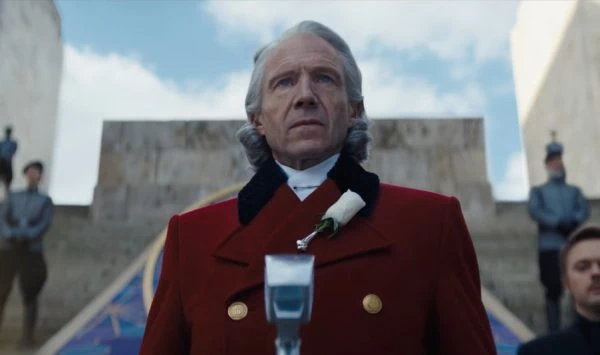
Glenn Close plays Drusilla Sickle, an escort from District Twelve in the Capitol, and Billy Porter plays her husband and lead stylist in the games. They match perfectly with their over-the-top outfits and makeup. Close, in particular, is very over the top, with the “too much plastic surgery” prosthetics making it appear as if Drusilla has killed her (Glenn Close) and is wearing her face. Maya Hawke, Lili Taylor, and Kelvin Harrison, Jr. could not achieve the same effect in their roles as Mentors due to not having enough screen time. However, with so many new and familiar characters, some characters would inevitably be given little screen time.
ALSO READ: The Good Daughter (2026) TV Review, Parents Guide & Age Rating
Despite this, all of the young fighters are impressive, even with small screen time. This film is impressive in the number of actors who would later become significant in the industry, all being present in the film. Not only are Haymitch’s squad impressive (Mackenna Grace plays Maysille, who is extremely bitter and determined, but despises Haymitch. However, she has an identical twin sister in her district who adored Haymitch; Molly McCann plays young Louella McCoy, who Haymitch sees as a little sister; Ben Wang plays Wyatt Callow, the son of an oddsmaker, who hopes to escape the bad reputation his family has), but some of their enemies and allies are also impressive. Standout performances include Jhaleil Swaby as a muscular brawler, Laura Alice Marcus as a red-haired Valkyrie with two axes, and Percy Daggs IV as a quiet revolutionary recruit, whose mentor is his father.
This film is shot in IMAX digital. In this film, the production design is very detailed and bright, taking inspiration from the 1960s and 1970s Sci-Fi styles seen in the rest of the series. Features include ties, long coats, voluminous hair, and patterned furniture and carpets. In every aspect of production, this film is the best of the six. In particular, it is incredibly impressive how diverse locations have been created. The houses of Snow and Plutarch are cavernous and very detailed. The lush green landscape (with a volcano!) where the majority of the games take place is also impressive.
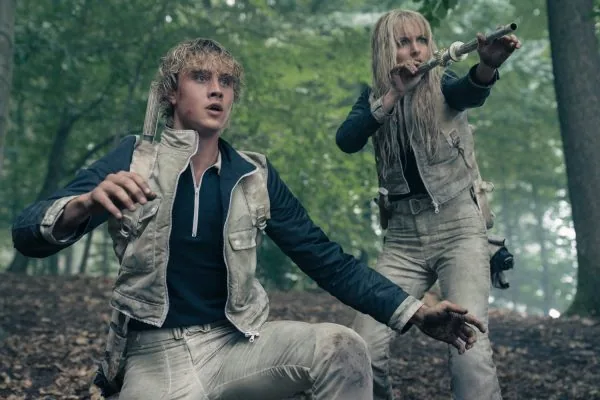
This is one of the greatest sets of the decade. Full of plant life, trees, bright flowers, and animal life (real or robotic, but all dangerous). The overall aesthetic of the film as a whole is impressively detailed. From the beginning of the games in particular, the detail is incredible. The trees, covered in veins, and the plants are very carefully planted.
The light coming through the canopy has created perfectly spaced beams of light. If a large woman in armour and a helmet walked in and began singing, it would be very fitting. All of the fighting takes place in a setting deliberately reminiscent of early 20th-century Germans’ silly fantasies of a white, Aryan ‘Fatherland’, consisting of handsome men and women and babies with pale skin and blond hair.
However, there are clever references and inspirations throughout this film from popular culture and fine art. Paintings of the river Rhine by Philip James de Loutherbourg, J.M.W. Turner, and less talented young artist Adolf Hitler are included. The Wizard of Oz references also run throughout the film, from eerie forest landscapes to Emerald City to flying monkeys. This may seem a bit much.
ALSO READ: Wild Horse Nine (2026) Review, Parents Guide & Age Rating
However, this all works very well and highlights connections between these different types of art/entertainment. As Walt Disney was curious about Nazi Germany, knowing this makes it impossible to watch Bambi without remembering, and watching this film makes one think about how Disney created extremely popular theme parks that entertained people but promoted ideologies about the ‘perfect small town’, ‘Wild West’, ‘Tomorrowland ’, etc. In this film, all of the fighters are in a sci-fi Nazi-themed park. The trees have eyes, and the cutest animals are the most dangerous; flowers and butterflies can kill you.
Although Collins’ books were dismissed by self-appointed literary protectors as ‘basic allegory novels’, this is actually a compliment. “Sunrise on the Reaping” is a film for fans who have known the stories since childhood, and have grown up in a political climate beginning post 9/11, and spanning through Trump’s second term. They may have children of their own now, who are intelligent, cynical, and radicalised against the world around them. As a result, they will appreciate this film in that it does not trick them.
The Hunger Games: Sunrise on the Reaping Content Breakdown
Why is The Hunger Games: Sunrise on the Reaping rated PG-13?
The Hunger Games: Sunrise on the Reaping is rated PG-13 by the MPAA for strong violence, bloody images, disturbing material, some smoking, and teen drinking.
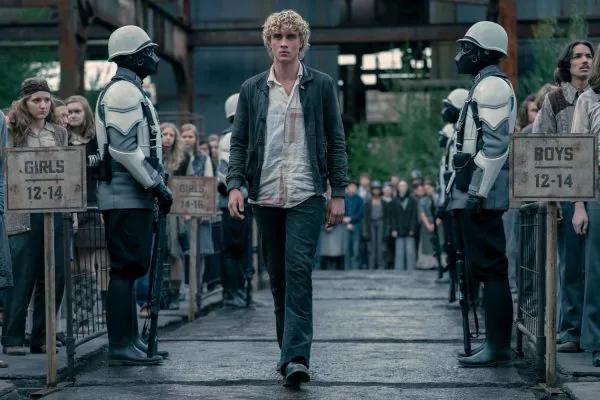
Violence: A violent clash breaks out at the reaping, and gunfire is used. Children and teens are forced into a gladiator-style contest staged as entertainment. Tributes are killed in combat, including by blows from hatchets and heavy weapons.
Fights show visible wounds and blood. Haymitch ends the film bruised and bloodied from repeated beatings. Late in the film, two exhausted fighters stumble through a brutal clash. Animals attack people, and people kill animals.
Antagonists poison food, candy, and water, and victims foam at the mouth and vomit. Explosions and arson occur, and a natural disaster strikes. One character attempts suicide for a cause. Reviewers describe more gore and a higher death count than in earlier films.
Sexual Content: There are no sex scenes. A teen couple shares hand-holding, kissing, and affectionate words. A few shots show naturalistic upper male nudity, which is non-sexual in context.
Profanity: Language is light. Early review tallies count about 3 crude terms across the 158-minute running time, plus arguments and insults. No sexual expletives, slurs, or deity terms have been reported.
Alcohol/Drug Use: Haymitch helps brew moonshine as a minor, and teen drinking is depicted. Later, his time in the Capitol drives him to heavy drinking, including drunkenness. Some adults smoke cigarettes and drink in Capitol scenes. No illegal drug use is reported.
Conclusion:
“Sunrise on the Reaping” is the story of Haymitch Abernathy, a decent teen from District 12 whose idealism is used against him in the 50th Hunger Games, turning him into the broken mentor fans already know. It is dark, smart, and technically the best film in the series, with a standout cast led by Joseph Zada, Jesse Plemons, and Ralph Fiennes.
The content guide matches its PG-13 rating: strong violence and bloody images, no sex scenes, very light language, and teen drinking and smoking. Common Sense Media suggests ages 14 and up, and the BBFC rates it 12A. I recommend it to franchise fans and mature teens who can handle heavy themes. Parents of younger viewers should preview it first, and anyone expecting a hopeful adventure should look elsewhere.

Rebecca Hollis is the founder of Screen Parent Guide and a film content analyst with seven years of experience reviewing films for an independent ratings consultancy. A Film Studies graduate of Emerson College, she specialized in content classification and how ratings systems communicate, and often fail to communicate, what families can expect from a movie.